Floor insulation grants are still available in 2026, but the route to accessing them has changed and the window for the most generous funded schemes is closing faster than many homeowners realise. The Great British Insulation Scheme, which covered floor insulation as an eligible measure for eligible households, closed on 31 March 2026. ECO4 continues to run until 31 December 2026 and floor insulation remains one of its supported measures. Alongside it, the new Warm Homes Local Grant is rolling out through local councils throughout the year. Together these two routes represent a genuine opportunity for eligible households to get their floors insulated at no cost, or at significantly reduced cost, before the end of the year.
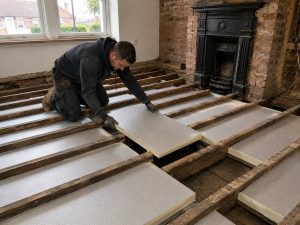
Floor insulation matters more than most homeowners appreciate. An uninsulated suspended timber floor can account for around 10 to 15 percent of a home’s total heat loss. For properties with older suspended floors where the boards sit over a cold, ventilated void, that heat loss is continuous and difficult to compensate for with heating alone. Insulating that void, either by fitting rigid boards between the joists from below or by lifting the floorboards and laying insulation from above, makes a measurable difference to the warmth of the property and a meaningful contribution to the EPC rating.
What Floor Insulation Grants Cover in 2026
ECO4 covers suspended timber floor insulation for eligible households as part of its package of energy efficiency measures. It does not typically cover solid concrete floor insulation under the same route, because the disruption and cost involved make it less commonly delivered as a standalone funded measure. If your home has a suspended timber ground floor, which is common in properties built before around 1930 and in many inter-war and post-war houses, ECO4 is the most direct funded route available.
Eligibility for ECO4 floor insulation grants requires that someone in the household receives a qualifying benefit. Universal Credit, Pension Credit, Child Tax Credit, Income Support, Jobseekers Allowance, and several other benefits qualify. The property also generally needs to have an EPC rating of D or below. An approved ECO4 installer will carry out a free eligibility check and if you qualify they will arrange a survey and installation at no cost to you.
The Warm Homes Local Grant, delivered through local councils, covers a broader range of measures including floor insulation. Eligibility varies by council but most programmes target households with lower incomes in less energy efficient homes. Some councils are running area based schemes where the floor insulation element is part of a broader whole house retrofit, which is particularly relevant for older properties where multiple measures are needed to achieve meaningful EPC improvement. Contact your local council directly and ask about their Warm Homes Local Grant programme or energy efficiency scheme for 2026.
The Warm Homes Plan Context
Floor insulation sits within the broader framework of the Warm Homes Plan, the government’s £15 billion commitment to upgrading five million UK homes by 2030. The plan identifies fabric improvements, meaning insulation of floors, walls, and roofs, as the foundation that must be in place before other clean energy measures like heat pumps can perform efficiently. A heat pump installed in a poorly insulated home with a cold, draughty floor will underperform against its rated efficiency. Floor insulation is therefore not just an energy saving measure in its own right. It is part of the building fabric baseline that the Warm Homes Plan is trying to establish across the UK housing stock.
For households that do not qualify for free grant support through ECO4 or the Warm Homes Local Grant, the Warm Homes Fund is expected to introduce low or zero interest loans for energy efficiency improvements later in 2026. Floor insulation is expected to be an eligible measure. The scheme details have not yet been confirmed but monitoring the government website and speaking to local installers means you will be positioned to act quickly when applications open.
Why Acting Before December Matters
The December 2026 ECO4 deadline is the most immediate pressure point for anyone seeking funded floor insulation. ECO4 closes on 31 December 2026 and there is no confirmed successor scheme that delivers the same level of free funded measures. Households that qualify but delay risk finding that installer capacity has been absorbed by the wave of last minute applicants that always accompanies a scheme deadline.
The practical timeline for an ECO4 floor insulation installation, from first contact with an installer to completed works, is typically between six and fourteen weeks. That means households looking to complete before the December deadline should be making enquiries before August at the latest. Earlier is better, particularly in areas where approved installers are in high demand.
Beyond the ECO4 deadline, the 2030 EPC C requirement for privately rented properties also creates urgency specifically for landlords. Floor insulation alone is unlikely to move a property from E to C, but as part of a broader package of measures it contributes meaningfully to the overall rating. Landlords who are planning their compliance pathway for 2030 should include floor insulation in their assessment, particularly for properties with suspended timber ground floors where the improvement is both technically straightforward and EPC-significant.
The combination of ECO4 still running, the Warm Homes Local Grant actively distributing funding, and the 2030 deadline creating longer term pressure makes 2026 the clearest moment in several years to act on floor insulation. The grants are real, the deadline is fixed, and the funding will not get more generous as the decade progresses.
 Find out more about us.