Floor insulation sits at the bottom of most homeowners’ priority lists. Loft insulation and wall insulation get more attention, more marketing, and more government funding. But for properties with suspended timber ground floors, and that includes the majority of pre war UK housing, floor insulation costs are worth it: it delivers comfort improvements that are difficult to achieve any other way, and at a cost that is often lower than people expect.
This article works through the decision honestly: when floor insulation is clearly worth doing, when the calculation is less clear, what it actually costs in 2026, and what you get for the money.
What Floor Insulation Actually Delivers
Before getting into costs, it is worth being specific about what floor insulation does, because the benefits divide into two distinct categories that appeal to different homeowners for different reasons.
Thermal Performance
An uninsulated suspended timber floor has a U value of approximately 0.7 to 1.0 W/m²K. With 100mm PIR insulation between the joists, that drops to around 0.18 to 0.25 W/m²K, a fourfold to fivefold improvement. Floor insulation accounts for roughly 10 to 15% of a typical pre war property’s total heat loss, so addressing it moves the needle meaningfully on both energy consumption and EPC rating.
Draught Elimination
This is the benefit that homeowners notice first and remember most. The gaps between floorboards, around the perimeter of skirting boards, and around pipework that penetrates the floor allow cold air from the subfloor void to circulate directly into the living space. This draughting effect makes rooms feel substantially colder than the air temperature would suggest, the chill you feel sitting on the floor, or the cold that seems to radiate up from the ground in winter despite the heating being on.
Floor insulation combined with draught sealing at the boards eliminates this entirely. Rooms feel warmer at the same air temperature, heat up faster, and maintain temperature with less heating input.
For homeowners in poorly insulated pre war properties, draught elimination is often the most immediately impactful improvement available, because it addresses discomfort that persists regardless of how hard the heating system works.
What Floor Insulation Costs in 2026
Costs depend primarily on floor type, access method, and property size.
Suspended Timber Floor: Access From Below
Where the subfloor void is accessible and deep enough for an installer to work in, this is the most cost effective approach. No boards come up. The existing floor is completely undisturbed.
| Property size | Estimated cost |
|---|---|
| Two bedroom terrace (approx 35m² ground floor) | £550 to £1,100 |
| Three bedroom semi (approx 50m² ground floor) | £800 to £1,500 |
| Three bedroom detached (approx 60m² ground floor) | £950 to £1,800 |
These figures assume PIR or EPS insulation fitted between joists with appropriate retaining, including a professional pre installation joist survey.
Suspended Timber Floor: Boards Lifted
Where below floor access is not possible, boards lift, insulation installs from above, and boards relay. The additional cost reflects the skilled labour of lifting and relaying boards without damaging them.
| Property size | Estimated cost |
|---|---|
| Two bedroom terrace | £1,100 to £2,000 |
| Three bedroom semi | £1,500 to £2,800 |
| Three bedroom detached | £1,800 to £3,500 |
Solid Concrete Floor: Floating Floor on Top
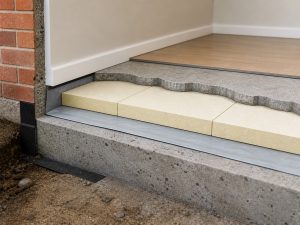
For solid floors, insulation boards lay on the existing concrete with a floating floor finish on top. This raises the floor level by 50 to 100mm, which requires adjusting door thresholds and skirting boards.
| Property size | Estimated cost |
|---|---|
| Two bedroom (approx 35m² ground floor) | £1,500 to £2,800 |
| Three bedroom (approx 50m² ground floor) | £2,000 to £4,000 |
What You Save on Energy Bills
The Energy Saving Trust estimates annual savings from floor insulation of £50 to £160 for a typical semi detached property, based on 2026 average energy prices. The range reflects the significant variation in floor area, heating system, energy tariff, and starting condition.
Properties at the higher end of the saving range tend to be those with:
- Larger ground floor areas with more exposed floor
- Gas central heating where the saving translates directly to reduced boiler output
- Poorly fitted or absent draught sealing at the boards (where draught elimination adds to the thermal saving)
- Properties where loft and wall insulation are already in place, making floor heat loss proportionally larger
At £100 savings per year and an installation cost of £1,000, the payback period on energy savings alone is 10 years. At £160 per year and £800 installation cost, it is five years. This is reasonable but not exceptional compared to other insulation measures, cavity wall insulation typically pays back faster, and loft insulation faster still.
When Floor Insulation Is Clearly Worth Doing
You Have a Pre War Property With a Suspended Floor and Cold Draughty Rooms
This is the strongest case. The draught elimination alone changes the feel of the ground floor substantially, and you get the thermal performance improvement on top. If you have not insulated your loft and walls, start there, but if those are done, the floor is the next logical step.
You Are Renovating the Ground Floor Anyway
If you are replacing the flooring, rewiring, or replumbing the ground floor, the incremental cost of insulating during the works is small because access and disruption costs are shared with the renovation. This is the best opportunity to insulate a floor cost effectively.
Your EPC Rating Is Close to a Band Threshold
Floor insulation typically adds 2 to 5 EPC points. If your current rating is 68 (the top of band D), floor insulation could push you into band C, which has meaningful implications for mortgage product availability, rental compliance, and property value. Check your current EPC potential rating table to see what impact the EPC assessor expects from floor insulation.
You Are Preparing for Heat Pump Installation
Heat pumps operate most efficiently when all fabric heat losses are minimised. A floor that loses heat steadily to the ground reduces the coefficient of performance of a heat pump installation. Insulating the floor before or alongside a heat pump installation improves the heat pump’s running efficiency.
When the Calculation Is Less Clear
You Have a Solid Concrete Floor With No Plans to Change the Floor Finish
Insulating a solid floor without other works means a floor level rise that requires adjusting doors, skirting, and connections to adjacent rooms. If you are not planning other works, this disruption and cost may not be worth the energy saving on its own.
Your Ground Floor Is Mostly Hard Flooring Over Concrete
Solid floors with hard flooring do not suffer the draughting that makes insulating suspended timber floors so impactful. The thermal improvement is real but the comfort improvement is less dramatic.
The Property Has Very Shallow Subfloor Void Access Issues
Where below floor access is not possible and the boards need to come up, costs rise to the point where the payback period extends to 15 years or more for a modest property. In this case, weigh the cost against the comfort benefit specifically, the financial case is weaker, but if cold draughty floors are a significant quality of life issue, the comfort benefit may still justify it.
Grant Funding for Floor Insulation
Floor insulation is an eligible measure under ECO4 and the Great British Insulation Scheme, though it is less commonly funded as a standalone measure than loft and wall insulation. It is more likely to be funded as part of a package of measures on a property with a poor EPC rating where multiple improvements are needed.
Contact a TrustMark registered, PAS 2030 certified installer to check current eligibility. If your household qualifies under ECO4, floor insulation may be included in a funded package at no cost to you.
Check out some of our floor insulation costs case studies
Frequently Asked Questions
How do I know if my floor is suspended or solid? Knock on the floor, a hollow sound indicates a void beneath. Check for airbricks in the lower section of the external walls, which confirm a subfloor void. A solid floor sits directly on concrete with no hollow sound and no airbricks.
Does floor insulation affect the EPC rating? Yes. Floor insulation is recorded on the EPC and typically adds 2 to 5 points to the score. For properties close to a band boundary, this can be decisive.
Can I insulate just one room? Yes, though doing the whole ground floor in one operation is more cost effective. Partial insulation leaves thermal bridges at the boundary between insulated and uninsulated sections.
What happens if my joists are rotten? The rot needs addressing before insulation proceeds. Do not install insulation over compromised joists, it masks the problem and prevents the repair work. A joist condition survey before installation is the right approach on any property more than 50 years old.
Is floor insulation worth doing if I have not insulated my loft yet? Loft insulation delivers a bigger impact per pound spent than floor insulation in most properties and should come first. Walls come second. Floor insulation is typically the third step in a fabric first approach to improving a property’s energy performance.
 Costs and savings correct as of April 2026. Grant eligibility criteria and funding levels change regularly, always confirm current availability with a registered installer.