Under floor insulation has always been sold as a winter upgrade. Keep the cold out, keep the warmth in, reduce your heating bills. That framing is correct but it is only half the story. In 2026, as UK summers become measurably hotter and longer, the same under floor insulation that protects you in January is working hard in July too. This article explains the science, the difference it makes in practice, and why mid summer is actually the best time to get it installed.
The UK Summer Heat Problem Is Getting Worse
The summer of 2022 was a turning point. Temperatures in England exceeded 40 degrees Celsius for the first time on record. The summers of 2023 and 2024 brought further prolonged heat events across the south and east of the country. In 2026, the pattern is clear. UK summers are hotter, longer, and harder to manage in homes that were built for a cooler climate.
Most English homes were designed to retain heat, not to deflect it. Large windows, south-facing walls, and minimal shading all made sense when the priority was capturing winter warmth. As a result, these same design features now contribute to overheating during summer.
The government’s UK Climate Risk Assessment identifies overheating in homes as one of the most serious and growing risks for English households. Ground floors play a specific role in this that most people overlook entirely.
How Under Floor Insulation Works in Summer
The key to understanding under floor insulation in summer is the temperature of the ground beneath your home.
Below around 3 metres, ground temperature in the UK stays remarkably stable throughout the year, sitting between 10 and 13 degrees Celsius. Even during a heatwave, the earth beneath your floor is considerably cooler than the air above it.
Without under floor insulation, this cooling potential is largely wasted. The cold from the ground dissipates upward through the floor structure and into the building fabric before it reaches the room in any meaningful way. The warm indoor air simply conducts its heat downward into the floor and then into the ground, but the exchange is slow and inefficient.
With under floor insulation, something more useful happens. The insulation layer keeps the floor structure itself cool by slowing the transfer of heat from the warm room above into the ground below. As a result, the floor surface stays cooler than it would without insulation. A cool floor surface then acts as a passive heat sink, absorbing warmth from the room slowly and moderating indoor temperature throughout the day.
Furthermore, well-insulated floors support the night purging strategy that works best in English homes during heatwaves. Opening windows wide after 10pm draws in cooler night air. Under floor insulation helps the floor retain that cool temperature into the following afternoon, acting as a natural buffer against the daily heat peak.
Under Floor Insulation in Winter: The Case You Already Know
The winter argument for under floor insulation is straightforward and well established. Uninsulated ground floors account for up to 15 percent of total heat loss in a typical English semi-detached house. Cold floors make rooms feel uncomfortable even when the air temperature is adequate. Heating systems work harder and run longer to compensate.
Under floor insulation eliminates the conductive heat loss through the floor. In suspended timber floors, it also stops the cold air circulation in the underfloor void that contributes significantly to draughts and cold spots at skirting board level.
The Energy Saving Trust estimates that properly installed under floor insulation can reduce heat loss through the floor by up to 70 percent in suspended timber properties. For solid concrete floors, the reduction is meaningful but depends more on insulation thickness and the U-value achieved.
For the Energy Saving Trust’s full guidance on insulation performance and costs, see here
Which Type of Under Floor Insulation Suits Your Home?
Suspended Timber Floors
Suspended timber floors are the most common target for under floor insulation in older UK properties. The floor sits above a void, and insulation goes between the joists to fill that void. Mineral wool batts are the most widely used material. They are flexible, non-combustible, and easy to cut to fit between joists of varying widths.
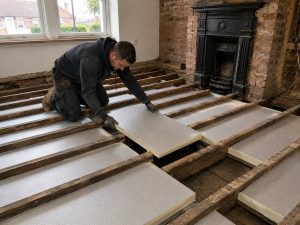
Rigid insulation boards are an alternative for suspended floors where the joist spacing is consistent and a higher performance per millimetre is needed. PIR boards achieve better thermal resistance at thinner profiles than mineral wool.
In addition, draught-proofing the gaps between floorboards dramatically improves the performance of joist insulation by stopping cold air from bypassing the insulation layer entirely.
Solid Concrete Floors
Solid concrete floors require a different approach. Rigid insulation boards go on top of the existing slab, followed by a new screed or floating floor finish. This raises the floor level by 50mm to 100mm, which requires adjustment to door thresholds and skirting boards.
However, solid floors have one advantage: high thermal mass. A well-insulated solid floor stores coolness effectively during summer and releases it slowly during the heat of the day. This thermal flywheel effect is more pronounced in solid floors than in timber ones.
Under Floor Insulation and Whole-Home Performance
Under floor insulation works best as part of a coordinated approach to home thermal performance. Floors, walls, and roofs all contribute to how well a home manages both winter cold and summer heat.
For a comprehensive overview of floor insulation types, costs, and materials, see our complete guide to floor insulation.
External wall insulation complements under floor insulation significantly. Walls are the largest surface area through which heat enters a home during summer. Our sister site covers how much external wall insulation costs and what the installation involves in detail.
Why Summer Is the Right Time to Install Under Floor Insulation
Mineral wool and rigid board insulation perform best when installed in dry conditions. Summer installation avoids the damp underfloor environments that can occur in autumn and winter, particularly in older properties with suspended floors above partially ventilated voids.
Furthermore, installers are less busy in summer than in the autumn booking rush. Surveys get scheduled faster, materials arrive sooner, and the work gets done before the seasons change in either direction.
If you are thinking about under floor insulation for winter warmth, the time to act is now. And if summer heat has become a problem in your home, under floor insulation addresses both at once.
 Get Expert Advice on Under Floor Insulation Today
Under floor insulation is one of the most cost-effective whole-year comfort upgrades available for English homes. Whether your priority is winter warmth, summer cooling, or damp prevention, contact us today and we will assess your floor type, recommend the right system, and advise on any grant funding available to you.
 Not Sure Which Option Is Right for You?