Retrofitting underfloor heating into a solid concrete floor is one of the more involved home improvement projects available. Solid floor insulation for underfloor is the element that most determines whether the system works efficiently or wastes most of its output heating the slab beneath it. Get the insulation right and the UFH performs quickly and cost effectively. Get it wrong and you have a heating system that is slow to respond, expensive to run, and unable to reach the temperatures you need.
This guide covers the specific insulation requirements for UFH retrofits into existing solid concrete floors , the decisions that matter, the mistakes to avoid, and the sequence that produces a working system.
Why Solid Floor Insulation for Underfloor Is Non Negotiable Under Retrofit UFH
A solid concrete floor is a significant thermal mass. It absorbs heat readily. Without insulation beneath the heating element, a meaningful proportion of the heat the system generates travels downward into the slab and from there into the ground beneath, rather than upward into the room.
The consequences are practical and financial:
Slow warm up times. The slab needs to heat up before the room above feels any benefit. Without insulation, the slab never fully warms because heat is constantly escaping downward. The system runs for extended periods without the room reaching target temperature.
High running costs. Heat escaping into the ground is wasted energy. A UFH system installed without adequate insulation routinely costs significantly more to run than the same system with correct insulation, because it needs to work harder and longer to maintain comfort.
Reduced flow temperature compatibility. Modern heat pumps operate most efficiently at low flow temperatures , typically 35 to 45°C. UFH is well suited to these temperatures because of its large surface area, but only if the insulation below the heating element is sufficient to prevent downward heat loss. Without adequate insulation, the system needs higher flow temperatures to compensate, which undermines heat pump efficiency.
The Part L Building Regulations require that where UFH installs in a new or substantially altered floor, the floor construction achieves a U value of 0.25 W/m²K or better. This is not achievable without meaningful insulation beneath the heating element.
The Insulation Options for Solid Floor UFH Retrofits
Under Screed Insulation (Full Strip)
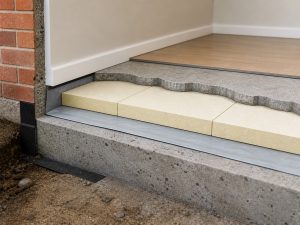
The most thermally effective approach. The existing floor finish and screed strip back to expose the concrete slab. Rigid insulation boards , typically PIR at 75 to 100mm thickness , lay on the slab surface. The UFH pipes or mats install on top of the insulation. A new screed goes over the pipes and insulation, finishing at or near the original floor level.
The thermal performance of this system is excellent. With 100mm PIR beneath the screed, the floor achieves a U value well below 0.25 W/m²K. The UFH responds quickly because the insulation prevents heat from escaping downward and directs it upward into the screed and the room.
The downside is disruption. Stripping the existing floor finish and screed involves a full room clearance, significant dust and debris, and a substantial programme of works. The floor level typically rises slightly if the new screed is thicker than the original, which can require adjusting door thresholds, skirting boards, and transitions to adjacent rooms.
Overlay System (No Strip)
Where stripping the existing floor is not practical , the existing screed is in good condition and the floor level must not rise significantly , an overlay system installs directly on top of the existing floor.
A thin insulation panel , typically 15 to 30mm of PIR , lays on the existing surface. A low profile UFH mat or a very thin screed over UFH pipes installs on top. The total floor build up is kept as thin as possible to minimise the floor level rise.
The thermal performance of this approach is lower than under screed insulation. At 20mm PIR, the insulation resistance is limited. The system compensates by using higher flow temperatures or running for longer periods. This is acceptable with a gas boiler but less compatible with a heat pump operating at low flow temperatures.
Overlay systems work best in situations where the primary driver is comfort enhancement rather than maximum energy efficiency, or where a heat pump is not in the plan.
Insulated Screed Panels
A hybrid approach using panels that combine insulation and a channel or groove for the UFH pipes in a single product. These install directly on the slab or on a thin base layer of insulation. The panels position the pipes at a consistent depth and spacing, which simplifies installation.
Insulated screed panels typically offer 25 to 50mm of insulation integrated into the panel. Where the slab is on solid ground with good thermal mass, this level of insulation can be adequate. On ground floors over poorly drained or cold ground, additional insulation below the panel is recommended.
The Sequence That Works
A correctly sequenced solid floor UFH retrofit follows these steps:
- Damp survey before anything else. Solid concrete floors can harbour rising damp, particularly in older properties where the damp proof membrane has failed or was never present. Installing insulation and a heated floor over rising damp traps moisture in the construction and causes problems within a few years. Any damp issues need diagnosing and treating before insulation goes in.
- Assess the existing floor level. Measure the existing floor height relative to door thresholds, adjacent room levels, and fixed elements such as kitchen units. Determine the maximum additional floor depth that can be accommodated without requiring major adjustments.
- Choose the insulation and UFH system. The insulation thickness and system type follow from the floor level assessment and the heating system. For heat pump compatibility, maximise insulation thickness within the available depth. For a gas boiler system where heat pump integration is not planned, a thinner overlay system may be acceptable.
- Prepare the existing floor. For under screed systems, strip to the slab. Clean and level the slab surface. Fill any cracks or voids. For overlay systems, the existing screed needs to be sound , any loose, hollow, or cracked areas need repair before overlaying.
- Install a damp proof membrane if not already present. A heavy duty polyethylene membrane on the slab surface provides a moisture barrier before the insulation goes on. For under screed systems, this also acts as a slip membrane between the slab and the insulation.
- Lay insulation boards. Boards butt tightly together with taped joints to prevent screed from leaking into the insulation layer during pouring. Boards turn up at the perimeter of the room to create an edge insulation layer that prevents heat from escaping into the surrounding walls.
- Install UFH pipes or mats. Pipes fix to the insulation surface using staples, clips, or a pre grooved panel. Flow and return connections route to the manifold location.
- Pressure test the system. The UFH circuit pressurises before screed goes on. Any leaks are fixed before the pipes are buried.
- Pour screed. Liquid screed (anhydrite) or sand and cement screed goes over the pipes. Liquid screed flows around pipes easily and reduces air pockets. It typically takes 24 to 48 hours to be walkable and four to six weeks to cure fully before the system can be commissioned.
- Commission the system. The UFH commissions gradually , starting at low temperatures and increasing over the first few weeks to dry the screed without cracking it.
Specific Considerations for 1960s and 1970s Concrete Floors
Properties built in the post war decades frequently have concrete ground floors with limited or no insulation. The concrete is often directly on a hardcore base with a thin screed on top. The damp proof membrane, if present, may be a bitumen coating on the slab rather than a modern polyethylene sheet.
These floors benefit significantly from UFH with good insulation below. But they often have characteristics that need addressing first:
Thin or cracked screed. Post war screeds were often laid relatively thin and have cracked over decades. Overlaying directly on a cracked screed transfers the cracks upward. A thin self levelling compound over the existing screed fills cracks and provides a flat surface for the insulation.
Poor or absent damp proofing. A new damp proof membrane at slab level is a standard specification item for retrofitting insulation and UFH into this generation of properties.
Lower floor to ceiling heights. Post war properties built to economy standards sometimes have lower floor to ceiling heights than older or newer properties. Any floor level rise from the UFH and insulation build up is more noticeable in a property where ceiling height is already limited.
Frequently Asked Questions about Solid Floor Insulation for Underfloor
How much does solid floor insulation and UFH retrofit cost? For a full strip and re screed with UFH on a typical 50m² ground floor, expect £4,000 to £8,000 for the insulation and screed element, plus £2,000 to £4,000 for the UFH pipe, manifold, and associated controls. Total costs vary significantly with floor area, access, and finish specification.
Can I install UFH without insulation below? Technically yes, but it is strongly inadvisable and in new construction it would not comply with Building Regulations. Without insulation, the system’s running costs increase substantially and its compatibility with low temperature heating such as heat pumps is compromised.
How long does it take to retrofit UFH with insulation into a solid floor? The stripping, insulation, and screed work typically takes three to five days for a typical ground floor room. The screed then needs four to six weeks to cure before commissioning. The total programme from start to operational system is typically six to eight weeks.
Does the floor level always rise with a solid floor UFH retrofit? With a full strip, the new build up can often match the original level if the existing screed is removed and the new screed is specified at the same depth. With an overlay system, some level rise is unavoidable. The extent depends on the insulation and screed thickness chosen.
 Costs and technical specifications correct as of April 2026. Always commission a damp survey before installing insulation or UFH on a solid concrete ground floor.