Floor insulation is often overlooked compared to loft and wall insulation, but it can deliver meaningful reductions in heat loss and energy bills, particularly in older properties with suspended timber floors. This guide covers every type of floor insulation suitable for UK homes, what they cost, and what grants are available.
Why Insulate Your Floor?
Around 10 to 15% of a home’s heat is lost through an uninsulated ground floor. In older properties with suspended timber floors, cold air circulates beneath the boards and draughts make rooms feel significantly colder than the actual temperature.
Insulating your floor:
- Reduces heat loss through the ground floor
- Eliminates cold draughts from beneath suspended floors
- Improves thermal comfort, floors feel warmer underfoot
- Can reduce energy bills by £50 to £160 per year
- Contributes to a better EPC rating
Types of Floor Construction in UK Homes
The right insulation approach depends on what type of floor you have. There are three main types found in UK homes.
Suspended Timber Ground Floors
The most common construction in properties built before the 1930s. Floorboards are laid on joists which are held above the ground on sleeper walls, creating a ventilated void beneath. This void is necessary to prevent damp and rot in the joists, but it also allows cold air to circulate freely beneath the floor.
Suspended timber floors are the easiest type to insulate and typically deliver the greatest comfort improvement.
Solid Concrete Ground Floors
Found in most properties built from the mid 20th century onwards. The floor is a concrete slab laid directly on a compacted hardcore base. There is no void beneath.
Insulating a solid concrete floor requires either lifting and relaying the screed with insulation underneath, or installing insulation on top of the existing slab, which raises the floor level by 50 to 100mm and requires adjusting door thresholds, skirting boards, and floor finishes.
Beam and Block Floors
A more recent construction method using precast concrete beams and infill blocks. Found in newer build properties. Insulation options are similar to solid concrete floors.
Types of Floor Insulation
Suspended Floor Insulation (Between Joists)
For suspended timber floors, rigid insulation boards or mineral wool batts are fitted between the floor joists, either from above (lifting floorboards) or from below (through the subfloor void via an access hatch).
Rigid insulation boards (PIR/EPS): high performance boards cut to fit snugly between joists. PIR (polyisocyanurate) delivers the best thermal performance per unit thickness. A 100mm PIR board can achieve a U value of around 0.25 W/m²K.
Mineral wool batts, flexible mineral wool cut to fit between joists and supported by netting or battens. Slightly lower performance than PIR but lower cost.
Blown in insulation, loose insulation (polystyrene bead or mineral wool) blown into the void from underneath via small holes, without lifting the floor. Only possible where adequate access exists and the void is free of obstructions.
Access from below through a crawl space is typically faster and less disruptive than lifting boards. If no access hatch exists, one can usually be formed.
Solid Floor Insulation (On Top or Underneath)
For solid concrete floors, options are:
Insulation below the screed, existing screed is removed, rigid insulation boards are laid on the slab, and a new screed or floating floor is installed on top. This achieves the best performance without raising the floor level significantly, but it is a major undertaking involving stripping back the floor finish, skirting, and often door thresholds.
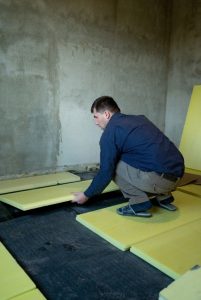
Floating floor on top, rigid insulation boards are laid directly on the existing concrete, topped with chipboard or engineered timber floating floor. Raises the floor level by 50 to 100mm. Requires adjustment of skirtings, doors, and connections to adjacent rooms.
Underfloor insulation mats, for use under certain floor finishes. Typically thinner than standard board insulation and lower performance, but suitable where floor level changes are not acceptable.
Underfloor Heating with Insulation
If you are installing or upgrading underfloor heating (UFH), floor insulation is essential to direct heat upwards rather than into the slab. UFH systems are typically installed with 50 to 100mm of rigid insulation beneath the heating pipes or mats.
Insulating beneath UFH also improves system efficiency and response times.
Floor Insulation Costs in 2026
| Floor Type and Method | Typical Cost |
|---|---|
| Suspended timber floor, between joists from below (per m²) | £15 to £30 |
| Suspended timber floor, boards lifted and relaid (per m²) | £25 to £50 |
| Solid floor, floating floor on top (per m²) | £30 to £60 |
| Solid floor, insulation under new screed (per m²) | £50 to £100 |
For a typical 40 to 50m² ground floor:
- Suspended floor (from below): £600 to £1,500
- Solid floor with floating finish: £1,200 to £3,000
Costs vary with access difficulty, insulation type chosen, and any associated making good (skirtings, door thresholds, finishes).
Floor Insulation Grants and Funding
Floor insulation can be funded under the same government schemes as wall and loft insulation in some circumstances.
ECO4
Energy company obligation funding can cover floor insulation as part of a broader package of energy efficiency measures for low income and fuel poor households. Floor insulation on its own is less commonly funded than loft or wall insulation, but it may be included as part of a multi measure project.
Great British Insulation Scheme (GBIS)
Aimed at properties in lower council tax bands or with poor EPC ratings. Floor insulation is eligible under GBIS where it is the primary measure needed to bring the property up to an acceptable standard.
Local Authority Schemes
Some local authorities run warm homes schemes that can include floor insulation as an eligible measure. Contact your local council’s energy efficiency team for availability in your area.
The fastest way to understand what funding you may be eligible for is to speak with a TrustMark registered installer who can assess your home and identify applicable schemes.
Does Floor Insulation Need Planning Permission?
No. Floor insulation is an internal alteration and does not require planning permission.
Building regulations approval is not routinely required for insulating an existing floor, unless the works involve structural changes or are part of a wider controlled work package. Your installer will advise on whether notification is needed in your specific case.
Floor Insulation and Damp
Moisture management is particularly important with floor insulation in older properties.
Suspended timber floors have a ventilated void for a reason: to keep the joists dry and prevent rot. Any insulation installed between the joists must not block the essential ventilation path through the void. The subfloor ventilation (airbricks) must be kept clear. A vapour control layer on the warm side of the insulation is recommended.
Solid concrete floors can suffer from rising damp if the damp proof membrane has failed or was not originally installed. Any floor insulation work should be preceded by a damp survey. If rising damp is present, it must be addressed before insulation is installed.
Never install insulation over a damp floor without treating the damp issue first.
Floor Insulation and Listed Buildings or Conservation Areas
Floor insulation is an internal measure and generally does not require listed building consent or conservation area approval unless the floor itself has heritage significance (e.g., original encaustic tiles or flagstones). If in doubt, consult your local planning authority before disturbing any original floor material.
Breathable, vapour open insulation materials (such as woodfibre or natural cork) are often preferred in historic buildings to avoid trapping moisture.
DIY vs Professional Floor Insulation
When DIY is feasible
Insulating a suspended timber floor from below, where good crawl space access exists and the void is clear, is one of the more accessible DIY insulation projects. The main requirements are:
- Safe access to the void (clearance of at least 400mm is needed to work comfortably)
- Correct sizing of insulation to fit between joists with a snug fit (no gaps at edges)
- Supporting the insulation with netting, battens, or retaining clips: it must not fall
PIR boards cut cleanly with a handsaw or utility knife. The work is dusty and physically demanding, but technically straightforward.
When to use a professional
If access is only possible by lifting floorboards, if the void contains obstructions, or if solid floor insulation is involved, professional installation is recommended. Incorrectly installed floor insulation, particularly on solid floors where floor level changes affect door operation and transitions to other rooms, can cause significant problems.
For any work funded through ECO4 or GBIS, a PAS 2030 certified, TrustMark registered installer is required.
Frequently Asked Questions
How much does floor insulation reduce bills?
The Energy Saving Trust estimates savings of £50 to £160 per year for a typical semi detached property, depending on floor type and system installed. Suspended timber floors generally deliver greater savings than solid floors because the starting level of heat loss is higher.
Does floor insulation make floors feel warmer?
Yes. Insulated suspended timber floors in particular feel dramatically warmer underfoot because draughts from the subfloor void are eliminated. This is often the most noticeable improvement.
Can I insulate under carpet?
Insulation must go beneath the floor structure (between joists or under screed), not simply under carpet. Thin insulating underlays are available for use directly under carpet but their thermal performance is much lower than structural floor insulation.
Will floor insulation cause damp or rot?
Only if installed incorrectly. Subfloor ventilation must be maintained in suspended floor properties, and damp issues must be resolved before installation in any floor type. A quality installer will survey for moisture risks before proceeding.
How long does floor insulation last?
Rigid board insulation installed between joists or under a screed will last the lifetime of the building. There are no moving parts and no degradation of performance over time if correctly installed and protected from moisture.
Is it worth insulating just the floor?
Floor insulation delivers the best return when it is part of an overall package including loft and wall insulation. If your loft and walls are already insulated, floor insulation is the logical next step and delivers meaningful comfort and energy saving benefits.
 Costs and grant information correct as of April 2026. Funding availability varies by region and changes regularly: contact a registered installer for current eligibility guidance.