Acoustic floor insulation and soundproof underlay are not the same thing, even though they are often used interchangeably online. If you buy the wrong one, you will spend money and still have a noise problem. This comparison breaks down exactly what each product does, where it performs well, and what kind of noise situation each one is built for.
What Is Acoustic Floor Insulation?
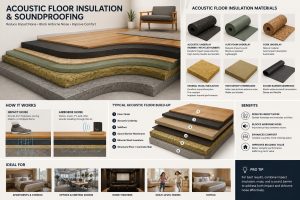
Acoustic floor insulation refers to a system or product fitted within or beneath the floor structure to reduce sound transmission. It typically involves one or more of the following.
- Dense mineral wool or acoustic batts installed between floor joists
- Resilient acoustic mats or boards used as a base layer beneath a new floor
- Full floating floor systems that decouple the finished surface from the structure below
Acoustic floor insulation is a more involved installation. It usually requires lifting the existing floor, accessing the void or joist space, and sometimes losing floor height. It targets both impact noise and airborne noise, depending on the system used.
What Is Soundproof Underlay?
Soundproof underlay is a single-layer product that sits directly beneath your finished floor covering, usually carpet, laminate, or engineered wood. It does not require structural work. You lay it on top of the existing subfloor and then lay your flooring on top.
Most soundproof underlays are made from dense rubber, recycled crumb rubber, foam composite, or felt. The denser the material, the better its acoustic performance. Budget foam underlays marketed as soundproof are largely ineffective. The products that actually perform tend to weigh considerably more.
Acoustic Floor Insulation vs Soundproof Underlay: Side by Side
| Acoustic Floor Insulation | Soundproof Underlay | |
| Installation | Requires structural work, floor access, or floating floor build-up | Laid directly on subfloor, no structural work needed |
| Impact noise | Excellent, especially floating floor systems | Moderate, depends heavily on density of product |
| Airborne noise | Good, particularly with joist infill included | Limited, not its primary function |
| Cost (materials) | £20 to £120 per square metre depending on system | £3 to £20 per square metre depending on density |
| Disruption | High, room may need to be cleared for several days | Low, can often be done in a few hours |
| Best for | Serious noise problems, party floors, conversions | Moderate noise, upgrading during a floor replacement |
Which One Is Right for Your Situation?
The answer depends on three things: how bad the noise problem is, whether you are replacing the floor anyway, and whether structural work is possible in your property.
Choose Soundproof Underlay If…
- You are replacing your carpet or laminate and want to improve acoustics at the same time
- Your noise problem is moderate, not severe
- You rent the property and cannot make structural changes
- Budget is the main constraint
Choose Acoustic Floor Insulation If…
- You own the property and the noise is a serious ongoing problem
- You are refurbishing and the floor is already being lifted
- The floor sits between two separate dwellings, such as a converted flat
- You want a long-term solution rather than a partial fix
What the Standards Say About Acoustic Floor Insulation
For properties undergoing conversion or material change of use, Part E of the Building Regulations sets minimum acoustic performance standards. The Energy Saving Trust also provides guidance on insulation performance in residential properties. For rental properties, landlords should be aware that poor acoustic separation can become a habitability issue and affect tenant retention.
A Note on Marketing Claims
Many underlay products are sold using decibel reduction claims that look impressive on paper but are measured under lab conditions that bear little resemblance to a real flat. A product claiming 19dB reduction in a lab might deliver 6 to 8dB in practice. Look for products with independent test data and check whether those tests measured impact noise, airborne noise, or both.
For context, a 10dB reduction means the sound is perceived as roughly half as loud. A 3dB reduction is barely noticeable to most people.
If you are specifically dealing with noise in a London flat, our article on floor noise insulation for London flats covers the specifics of timber and concrete floor types in converted properties.
Does Your Ceiling Also Need Attention?
Floors and ceilings work together. Treating the floor helps the flat below. But if you are the flat below, you may need to treat your ceiling independently. Our sister site wallinsulation.co.uk covers internal wall and ceiling insulation options that complement floor treatments for a more complete acoustic solution.
 Not Sure Which Option Is Right for You?
Every floor and every noise problem is different. Contact us and we will help you choose between acoustic floor insulation and soundproof underlay based on your actual situation, not a generic recommendation.