Floor insulation Manchester homeowners need is shaped by the city’s housing stock and its famously damp, cool climate. Greater Manchester has one of the highest concentrations of Victorian terraced housing in the UK. Neighbourhoods like Salford, Hulme, Levenshulme, Chorlton, and Gorton are packed with pre-war properties that rely on suspended timber floors, and a large number of these homes remain uninsulated beneath the floorboards. This guide explains what Manchester homeowners need to know about floor insulation in 2026.
Why Manchester Properties Lose More Heat Through the Floor
Manchester’s climate is wetter and cooler on average than many parts of England. Therefore, the impact of an uninsulated ground floor is felt more acutely here than in warmer regions. In a typical Greater Manchester Victorian terrace, a suspended timber floor with no insulation can account for up to 15% of total heat loss. Over a full heating season, that adds up to a meaningful amount of wasted energy and money.
Furthermore, Manchester’s high rainfall means that moisture management beneath suspended timber floors is especially important. A well installed floor insulation system includes attention to ventilation and vapour control, which helps protect the floor structure from damp as well as keeping the rooms above warmer.
In addition to Victorian terraces, Greater Manchester also has a large stock of post war semi detached and detached housing, particularly in areas like Stockport, Trafford, and Bury, where solid concrete ground floors are more common. These properties have different insulation requirements but equally benefit from the upgrade.
Types of Floor Insulation for Manchester Homes
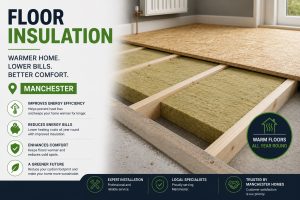
Suspended timber floor insulation is the most relevant type for Manchester’s older terraces and semi detached houses built before the 1940s. Mineral wool or rigid foam boards are fitted between the joists beneath the floorboards. In most cases, installers access the void from below through airbricks without lifting the floor surface, which keeps disruption minimal.
Solid concrete floor insulation is more common in post war properties and purpose built flats across Greater Manchester. Rigid insulation boards are laid on top of the existing slab and covered with a new floor finish. This raises the floor height slightly and may require minor adjustments to doors and skirting boards.
Spray foam is sometimes suggested for hard to access suspended floors, but it is generally not recommended in the Greater Manchester area due to the region’s higher moisture levels and the complications spray foam can cause for future mortgage valuations.
How Much Does Floor Insulation Cost in Manchester in 2026?
Costs in Greater Manchester are broadly in line with the northern English average. As a guide for 2026:
Suspended timber floor insulation in a Manchester terrace typically costs between 400 and 1,100 pounds, depending on floor area and access conditions.
Solid concrete floor insulation typically costs between 1,500 and 3,800 pounds for a standard ground floor, depending on the area being treated and any finishing works required.
Always get at least three quotes from registered local installers. Prices can vary based on the condition of the existing floor structure, the accessibility of the void beneath the floor, and whether any preparatory damp or remedial work is needed first.
Grants for Floor Insulation in Manchester
Manchester homeowners may qualify for funding through the ECO4 scheme or the Great British Insulation Scheme in 2026. Both schemes cover floor insulation for eligible households, and eligibility depends on household income, property EPC rating, and property type.
Greater Manchester Combined Authority has also been active in supporting home energy efficiency improvements, so it is worth checking with your local council for any regional or borough specific schemes running in your area.
The Energy Saving Trust has comprehensive guidance on floor insulation and what financial support is available, which you can find at their dedicated page.
For a full breakdown of floor insulation options by property type, our complete floor insulation guide is a useful starting point..
Key Considerations for Manchester Properties Before You Book
Damp is a significant concern in Greater Manchester, both because of the climate and because many older properties have a history of penetrating damp, rising damp, or poor drainage around the foundations. A thorough damp assessment before installation is not optional. Any installer who skips this step is cutting corners.
Airbrick condition is also worth checking in Manchester’s older terraces. Suspended timber floors depend on airbrick ventilation to stay dry, and it is common to find airbricks partially blocked by render, soil build up, or previous owners’ well intentioned but misguided attempts to stop draughts. A quality installer will check and clear these as part of the job.
Finally, checking and refreshing your EPC after installation is worthwhile. A higher EPC rating helps if you plan to sell or let your Manchester property and may also improve your eligibility for future grant funding. For everything you need to know about EPC certificates, our sister site has a full guide: EPC certificate.
How Long Does Floor Insulation Take in a Manchester Home?
Suspended timber floor insulation typically takes one to two days in a standard Manchester terrace, with no need to vacate the property.
Solid concrete floor insulation takes longer, usually three to five days per floor area treated, and the space will need to be cleared during works. However, in a typical semi detached Manchester property, the disruption is manageable and the results are long lasting.
 Ready to Insulate Your Manchester Home?
Our team works with Greater Manchester homeowners to find the right floor insulation solution, confirm grant eligibility, and connect with trusted installers who understand the local property market.
Contact us today for a free, no obligation consultation covering all areas of Greater Manchester.