Floor insulation Birmingham homeowners need depends almost entirely on the age and construction of their property. Birmingham has one of the most diverse housing stocks of any UK city outside London, ranging from Victorian back to back terraces in Balsall Heath and Sparkbrook to post war council estates in Castle Vale and Chelmsley Wood and newer builds across Edgbaston and Solihull. Each property type has different floor insulation requirements, and getting the right solution matters both for comfort and for energy efficiency.
This guide covers what Birmingham homeowners need to know before booking any work in 2026.
Birmingham’s Housing Stock and Why It Matters for Floor Insulation
A significant proportion of Birmingham’s older properties feature suspended timber ground floors. These were standard in houses built from the mid Victorian era through to approximately the 1930s, and they remain common throughout inner city neighbourhoods including Handsworth, Moseley, Kings Heath, and Erdington.
Suspended timber floors have a ventilated void beneath them. Without insulation between the joists, cold air circulates in this void and drives heat out of the room above. Therefore, homeowners in these areas often find that their ground floors remain cold even when the central heating is running at full capacity.
In contrast, post war properties and council housing built from the 1950s through the 1980s typically have solid concrete ground floors. These do not suffer from the same draughty void problem, but they are still poor thermal performers without insulation. Furthermore, Birmingham’s colder winters compared to the south of England mean that heat loss through an uninsulated concrete slab is a genuine and consistent drain on energy bills.
Types of Floor Insulation Suitable for Birmingham Homes
Suspended timber floor insulation is the most common type of installation in Birmingham’s older housing. Mineral wool batts or rigid foam boards are fitted between the floor joists from below, typically accessed through airbricks or a hatch in the floor. In most cases, the floorboards do not need to be lifted, which keeps the work quick and minimises disruption.
Solid floor insulation involves laying rigid insulation boards directly on top of the existing concrete slab. The boards are then covered with a floating floor or screed finish. This raises the floor level slightly, so doors and floor coverings need to account for the new height. However, the thermal improvement is significant and the installation is durable.
If your Birmingham property has a basement or cellar, you may also benefit from insulating the ceiling of that space, which achieves a similar effect to floor insulation for the rooms above.
How Much Does Floor Insulation Cost in Birmingham in 2026?
Birmingham labour costs are generally lower than London but in line with the Midlands average. As a guide for 2026:
Suspended timber floor insulation in a Birmingham mid terrace typically costs between 400 and 1,200 pounds, depending on floor area and access.
Solid concrete floor insulation in a Birmingham semi or detached property typically costs between 1,500 and 4,000 pounds, depending on floor area and the finishing work required.
These are estimates. Get at least three quotes from registered local installers before committing to any work. Prices can vary considerably depending on the condition of the existing floor structure and how easy it is to access the void beneath.
Grants for Floor Insulation in Birmingham
Birmingham homeowners may qualify for significant grant funding in 2026. The ECO4 scheme and the Great British Insulation Scheme both cover floor insulation for eligible households. Eligibility typically depends on household income, the current EPC rating of the property, and the type of property.
Birmingham City Council has also supported local energy efficiency programmes in recent years, so it is worth checking with the council’s housing team for any additional local schemes running in your area.
For a broader understanding of floor insulation options across different property types, our full floor insulation guide covers everything in detail.
What to Check Before Getting Floor Insulation in Birmingham
Damp is a consideration in many of Birmingham’s older terraces and back to backs. Before any insulation work begins, a damp assessment is essential. Rising damp or penetrating damp in the floor structure must be resolved before insulation is installed, or the problem will be made significantly worse.
In Birmingham’s older housing, it is also common to find that airbricks beneath suspended timber floors have been painted over or partially blocked by previous owners. A good installer will check these and clear them as part of the installation, because ventilation beneath a suspended timber floor is essential to prevent rot.
You should also consider your EPC rating before and after the work. A higher EPC rating after installation has practical benefits for selling or letting your Birmingham property. For more information on EPC certificates and what they mean for your home, our sister site has a comprehensive EPC certificate guide: EPC certificate.
How Long Does the Work Take?
For suspended timber floors in a Birmingham terrace, most installations complete within one to two days with minimal disruption to the household.
For solid concrete floor insulation, the process typically takes three to five days and the room being treated will need to be clear of furniture throughout. In a typical Birmingham semi detached house, this usually means working room by room across the ground floor.
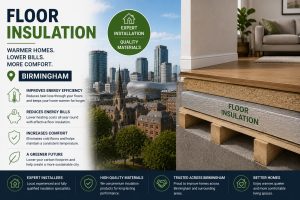 Ready to Improve Your Birmingham Home’s Energy Efficiency?
Our team helps Birmingham homeowners find the right floor insulation solution for their property, check grant eligibility, and connect with trusted local installers who know the city’s housing stock.
Contact us today for a free, no obligation consultation.