Floor insulation Liverpool homeowners need is heavily influenced by the city’s distinctive Victorian and Edwardian housing stock. Liverpool has a remarkable concentration of pre-war terraced housing, particularly across the inner city neighbourhoods of Toxteth, Kirkdale, Wavertree, Anfield, and Kensington. The vast majority of these properties were built with suspended timber floors, and a large number remain uninsulated to this day. This guide gives Liverpool and Merseyside homeowners a clear picture of what floor insulation involves in 2026, including costs, grants, and what to look for in a local installer.
Liverpool’s Housing and the Floor Insulation Opportunity
Liverpool’s built environment tells the story of a city that expanded rapidly during the nineteenth century. As a result, a very high proportion of the city’s housing stock dates from the 1860s through to the 1910s. These properties were built on a standard plan: solid brick walls, a slate or clay tile roof, and a suspended timber ground floor with a ventilated void beneath.
That void was an important design feature, intended to keep the floor structure dry. However, it also means that without insulation between the joists, cold outside air continuously exchanges beneath the living space and drives heat downward. Therefore, Liverpool homeowners in older terraces often report that their ground floors feel significantly colder than the rest of the house, even in a well heated home.
Furthermore, Liverpool’s coastal exposure and prevailing westerly winds make the city one of the windier urban environments in England. This increases the rate at which cold air circulates beneath suspended floors, which makes the case for floor insulation even stronger than in more sheltered locations.
The Right Type of Floor Insulation for Liverpool Properties
The solution depends on your floor construction. Liverpool properties generally fall into one of two types.
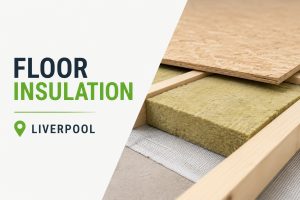
Suspended timber floors dominate in pre-war Liverpool housing. The standard installation approach is to fit mineral wool or rigid foam boards between the joists beneath the floorboards, accessing the void from below through airbricks or a purpose drilled access point. In most Liverpool terraces, this can be done without lifting the floors, which keeps the work clean and quick.
Solid concrete floors are more typical in post-war council housing and the system built estates developed across Merseyside from the 1950s onwards. These are insulated by laying rigid board insulation on top of the existing slab and finishing with a new floor surface. The floor height rises slightly as a result, but the thermal improvement is substantial.
How Much Does Floor Insulation Cost in Liverpool in 2026?
Liverpool labour costs are generally competitive compared to the national average. As a guide:
Suspended timber floor insulation in a Liverpool terrace typically costs between 350 and 1,100 pounds, depending on floor area and the ease of access beneath the floor.
Solid concrete floor insulation typically costs between 1,400 and 3,800 pounds for a standard ground floor, depending on floor area and what finishing work is included.
Get at least three quotes before committing. Prices vary depending on the condition of the existing floor structure, the level of damp risk, and the access route available to the installer beneath the floor.
Floor Insulation Grants in Liverpool
Liverpool homeowners are well placed to benefit from government grant funding in 2026. The ECO4 scheme and the Great British Insulation Scheme both cover floor insulation, and Merseyside’s housing stock and household income profile means that a significant number of Liverpool properties qualify.
Liverpool City Council and the Liverpool City Region Combined Authority have both supported local energy efficiency initiatives in recent years. It is therefore worth contacting your local authority as well as your energy supplier to check what is currently available in your area.
The Energy Saving Trust has a practical and regularly updated guide to floor insulation and available financial support.
For a full overview of floor insulation options and how they apply to different property types, our complete guide is a good place to start.
Things to Check Before Booking a Liverpool Installer
Damp is a genuine concern in many of Liverpool’s older properties, particularly those close to the Mersey or in lower lying parts of the city. Before any floor insulation work begins, a damp survey is essential. Rising damp in the floor structure must be resolved before insulation is installed.
Airbrick condition matters in Liverpool’s terraces. These small vents allow air to circulate beneath the suspended floor and prevent the timber from rotting. However, in older Liverpool properties it is common to find airbricks partially blocked or painted over. A quality installer will check these as part of the survey and clear them before beginning installation.
It is also worth thinking about your EPC. A new EPC after floor insulation work will reflect the improvement to your property’s energy performance rating, which helps with selling or letting. For more on what an EPC means for your property, our sister site has a comprehensive guide: EPC certificate .
How Long Does Floor Insulation Take in Liverpool?
For a suspended timber floor in a Liverpool terrace, most installations complete in one to two days. The work is done from below through the void, so your living space stays usable throughout.
For solid concrete floor insulation, the process typically takes three to five days per area treated. The room or rooms being worked on will need to be cleared of furniture during this time.
 Ready to Insulate Your Liverpool Home?
Our team helps Liverpool and Merseyside homeowners find the right floor insulation solution, check grant eligibility, and connect with trusted local installers.
Contact us today for a free, no obligation consultation. We cover all areas of Liverpool and the wider Merseyside region.