Ask most installers about floor insulation and boards come up first, almost every time. Floor insulation rolls rarely get mentioned, even though they are often cheaper and, for the right kind of floor, perform the job just as well. That is not because rolls are a bad product. It comes down to what makes an installer’s job predictable, and boards win on that far more than price.
What Floor Insulation Rolls Actually Are
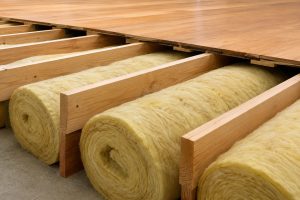
Floor insulation rolls are flexible sheets, usually mineral wool, fibreglass, or increasingly sheep wool, designed to fit between floor joists on a suspended timber floor. According to the Energy Saving Trust, timber floors are typically insulated by lifting the floorboards and laying mineral wool insulation supported by netting between the joists. Rolls are the standard material for exactly this job.
Because they are flexible, floor insulation rolls conform easily to slightly uneven joist spacing and awkward corners, which rigid boards cannot do without extra cutting. For a straightforward suspended timber floor in reasonable condition, this makes rolls a genuinely practical, lower cost option.
What Floor Insulation Boards Do Differently
Boards are rigid sheets, most commonly PIR, that are used on solid concrete floors, either laid on top of the existing slab or incorporated during construction. Concrete floors do not have joists to fit material between, so a flexible product does not have anywhere to go. Boards fill that gap.
On suspended timber floors, however, boards can also be used, and this is where the real comparison starts. PIR boards achieve a much lower thermal conductivity than mineral wool, roughly 0.022 W per metre kelvin against roughly 0.035 for mineral wool. In practice, that means boards reach current UK building regulation targets in a thinner layer than rolls need to hit the same performance.
The Real Reason Installers Lean Toward Boards
This is the part rarely explained clearly. It is not that rolls perform badly, it is that boards make the outcome more predictable for the person doing the work. A thinner layer that reliably hits a target U value is easier to guarantee, easier to defend if building control asks questions, and less likely to generate a comeback if performance falls short.
Rolls depend more on installation quality. Gaps, compression, or netting that sags over time can all reduce real world performance below what the product is rated for on paper. Boards, once fitted correctly, do not compress in the same way. For an installer whose reputation and warranty rest on getting this right first time, that difference in risk matters more than the material’s upfront cost to the homeowner.
None of this means floor insulation rolls are the wrong choice. It means the incentive to recommend the safer, more predictable option often outweighs the incentive to mention the cheaper one, even when the cheaper one would genuinely work.
When Floor Insulation Rolls Are Genuinely the Right Call
If your floor is a suspended timber floor in reasonable condition, with joists at a fairly regular spacing and easy access underneath, floor insulation rolls are a sound, lower cost option. Mineral wool rolls also offer stronger acoustic performance than most boards, which is worth factoring in if noise between floors matters to you.
Where rolls are less suitable is on solid concrete floors, where there are no joists to hold the material in place, and in situations where ceiling height is already tight, since boards achieve equivalent performance in a thinner layer. If headroom below the floor is limited, that thinner profile genuinely earns its higher price.
How to Ask the Right Question
If you are getting quotes for floor insulation and only boards are mentioned, it is reasonable to ask directly whether floor insulation rolls would work for your floor type, and if not, why not. A good installer should be able to explain the reasoning in terms of your specific floor, not just default to the higher spec option without discussion.
For a fuller breakdown of how different floor types are insulated and which method suits each one, our complete guide to floor insulation covers suspended timber, solid concrete, and everything in between.
 Getting a Straight Answer
Floor insulation rolls are not automatically the wrong choice, and they are not automatically the right one either. The honest answer depends on your floor construction, and it is worth getting a proper explanation rather than accepting one material as the default. If floor performance matters to you alongside wall performance, our guide to wall insulation is a useful companion read, since the two are often assessed together as part of a wider fabric first approach.
For more detail on what actually goes into floor insulation, including U values and building regulation requirements, see the Energy Saving Trust’s floor insulation guide. If you want a straight answer on whether floor insulation rolls would suit your home, get in touch with our team for an honest assessment, not just the default option.